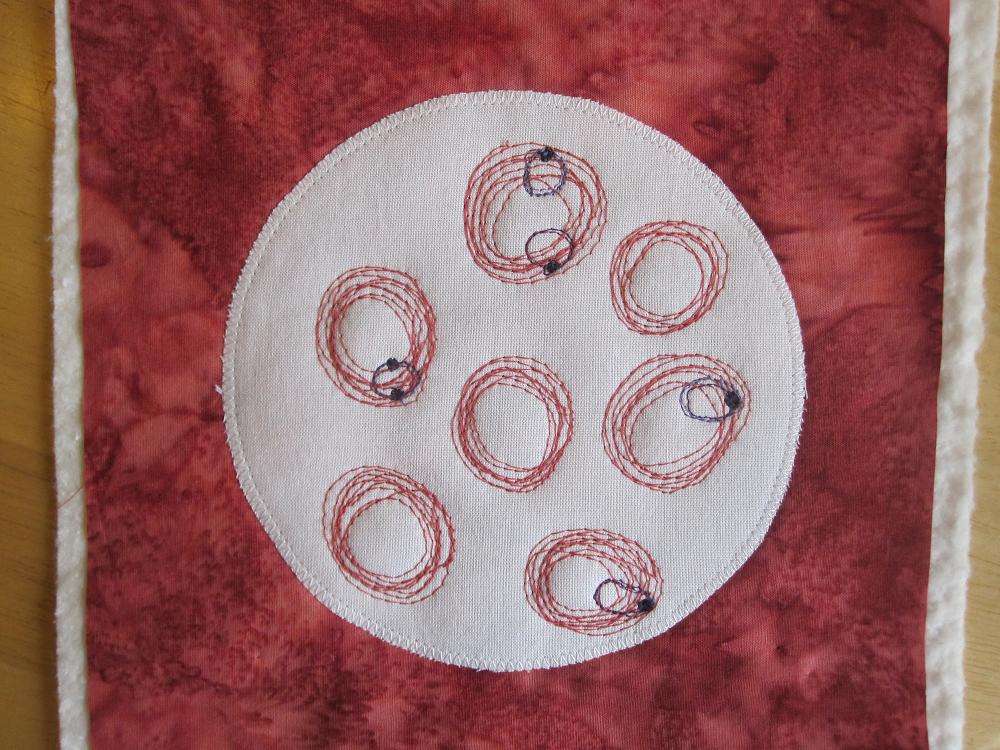
Malaria is a disease that I myself have only really seen once in all of my years in the lab. It is a parasite that is spread through mosquito bites, and in the United States, mosquito control programs have made malaria almost non-existent here. But in many tropical and sub-tropical regions of the world, malaria is a real threat, and causes millions of people to get very ill and sometimes die. Most of the malaria cases diagnosed in the US are from people who have traveled from areas where malaria is present. Indeed, the one case I "found" in our lab was from such a traveler. A doctor can also order a malaria smear if they suspect this in their patient. But malaria is a disease that "waxes and wanes", so a negative smear won't completely rule it out.
The malaria parasite spends part of its life cycle in the human red blood cell. Other life cycles forms can be seen on a blood smear, but the "ring form" is the most common. These little tiny rings can be seen inside of the red blood cell. Luckily there is treatment for malaria, and ways to prevent it.
I made my red blood cells really big so that I could try to make the ring form of malaria easier to see and sew. Once again, I got a bit frustrated trying to draw something using thread and fabric that is seen on a slide under a light microscope. But hey, I'm learning a little bit each day!
Speaking of learning, I though I'd share a quick tutorial of a "twisted" 9-patch quilt that I just finished. I was itching to get it done, as the blocks were finished a few months ago, but put away as I worked on Christmas presents. I finished the top yesterday, and my husband was home today for lunch and helped me get a good picture of it (even though it was a bit windy). One thing this quilt taught me is that black isn't all black. I had some black fabric that I bought in Michigan, and used this all up. When I bought what I thought was the closest match here in Oregon, only after sewing it all together did I really notice the difference! Oh well...
 A friend of mine told me about this technique about a year ago. After seeing it on many blogs and in local quilt shows, I decided to make one myself. It's super-easy and looks great when finished! When a local store had a sale on fat quarters, I bought 8 of the blue batik fat quarters, then cut out 4, 9 x 9 inch squares from each of them, so I had 32 in all. I took 2 yards of black fabric and cut out 32, 9 inch squares, and half a yard of the yellow batik, and cut out 8, 9 inch squares. I sewed them all in 9 patch blocks like this:
Then I cut each of these 9-patch blocks in half both vertically and horizontally, like this:


Now I had 4 smaller blocks. I twisted them and rearranged them into rows of 5 across, then sewed 6 of these rows together. I had 2 left over small blocks. I hope that makes sense. If you haven't sewed one up yet, do it! This one was so fun and easy!


