Showing posts with label fun-a-day. Show all posts
Saturday, February 12, 2011
Fun-a-day reception / art show
Last night was the reception for our local fun-a-day project. There were a few dozen participants in the area, and last night the turn out was great! I got to meet some of the other artists, and see what everyone else worked on over the month of January! There are so many creative talented artists around here! It was pretty crowded, so I didn't get as many pictures as I would have liked, plus I had the whole family with me, but here's a few I took last night. There were many others, including a set of dozens of earnings and jewelry, woodworking pieces, photos, videos, sketches, crochet and various other mixed-media projects.
My friend and quilting teacher also made not 1, but 2 quilts, and 3 quilt tops! I LOVE this one! I'm seeing more and more circles these days in quilts!! So cool! I wish I had got a close-up of her free motion quilting on it. It's amazing!
These are all continuous line drawing done "blind". The artist never lifted the pencil, and did not look at the paper while she was drawing! My mind is already trying to figure out how to do something like this on my next quilt! So neat!
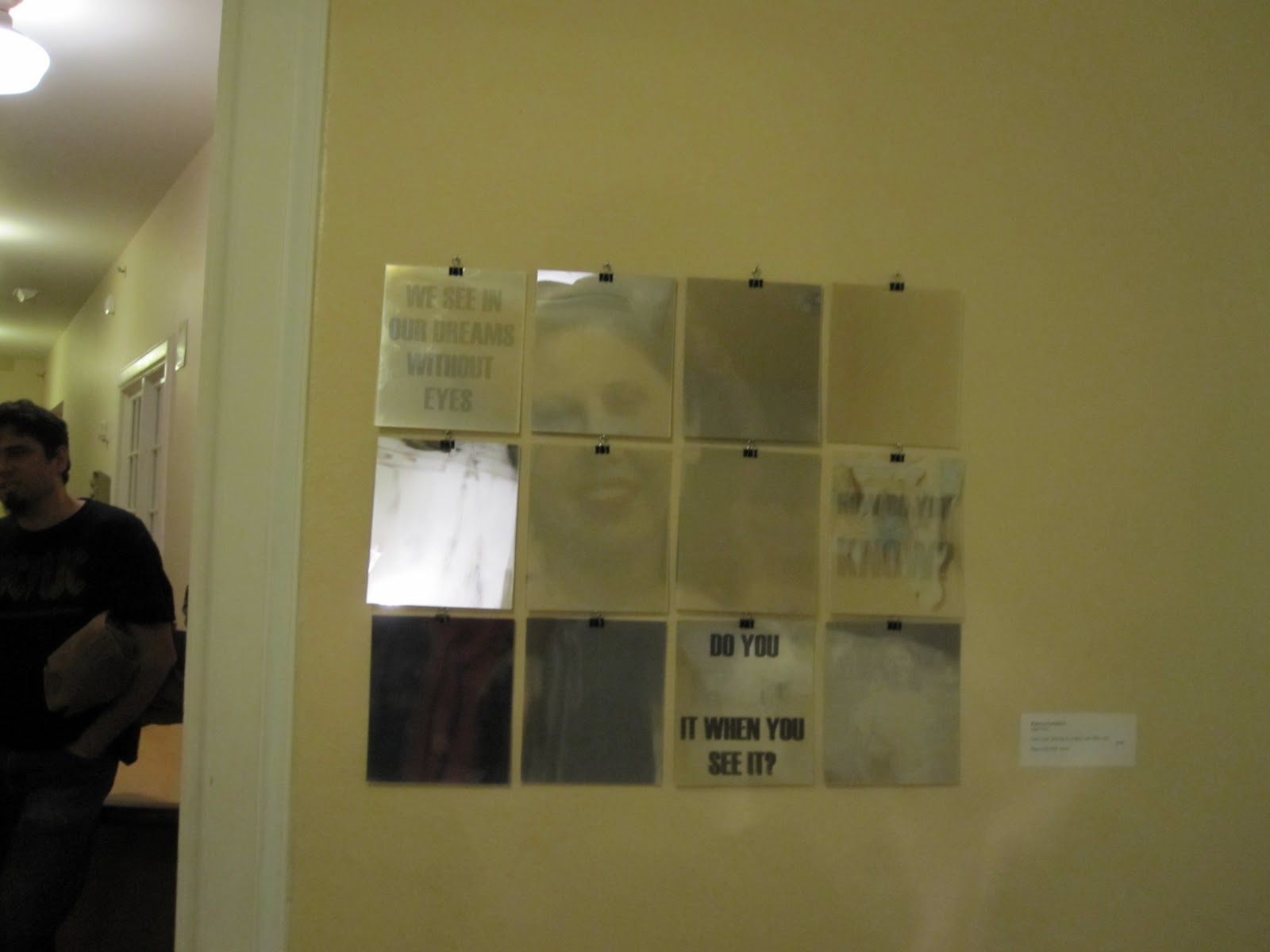
These were images printed on multiple layers of clear acetate, then all stacked up. It's not the best picture, but one of those squares can have many layers, adding depth and dimension. I never knew you could do something like that!!
Someone else made a handmade card each day. Each one has an inspirational / spiritual message inside! I had time to read a few, but not all.
In this last picture, someone had created several hand made, hand bound little books! This was hands down, my kids favorite! They also liked one that had many various items, including origami, and some tiny little folded paper structures that said "please take one". What a great idea!!
Kids really like to touch things, and this town, and the art center are very kid-friendly. I made a mental note to keep that in mind next time I make an "art quilt". The ones I've made so far I really don't plan to wash, but in the future I think I'll try to keep them all washable so that kids can touch them, because they really like that so much!! My quilt is against the far wall in the top picture. I got a lot of nice comments about it! You can also see a few other fun-a-day projects along the wall to the right. I feel lucky to live in a town with such a neat center for the arts. They really do add so much to the community, and I'm thankful!!
Saturday, February 5, 2011
Medical Lab Quilt FINISHED!!
It's done!! I'm so excited! I finished it up last night, and dropped it off at the art center today. It will be in our fun-a-day reception on Friday night! I also agreed to allow it to travel to neighboring communities. Cool! I did not agree to put a price on it. How do you sell your work? I really could use the money, but this quilt is pretty special to me. I'm thinking about making some "duplicates" to sell though...
I love seeing pictures of where other people live, so I took a few pictures when I dropped it off. Here's the art Center. Behind it is a mostly residential part of town...
The art center sits right next to the Umatilla River, which flows into the Columbia River.
Across the river is the rest of our Main Street. I happened to get a neat old car driving through town when I took this picture!
Enjoy!
Friday, February 4, 2011
Almost done, and yes, I still hate hand sewing!!
Thought I'd post a little progress. I finally caved and went to the doctor yesterday. Sinus infection... ick! I felt so bad the last few days that I haven't even done much sewing. But I really need to get this done! So in a cold-medicine-induced cloud, I have been spending most of the day working on it. I'm wishing now that I'd reversed the process and machine stitched the nice part on the back, then I'd be able to machine sew the binding in place on the front. It wouldn't look as good, but it'd probably be done by now!
Have you ever got to the end of a quilt and just wanted to hide it away for a while! Ugh! I know I'll be glad when it's done though! Hopefully tonight or tomorrow! I'm also happy to report that so far no real blood has been shed yet :-).
Tuesday, February 1, 2011
Ready, set, SEW!
I'm afraid that not only have I been under the weather the last few days, but our internet provider has been having some serious problems as well. After much trouble shooting and pulling of hair, DH finally called them last night, and they told us of the problems. Sure would be nice if they sent us an email, 'ya know... The main problems is uploads, so I shrunk all of my pictures WAY down. So far, so good!
I spent much of last week making up some Kindle covers to try to sell on Etsy. Here's one of my favorites. I also finally figured out how to put buttons on my blog (yippee!). The Etsy button on my blog is a link to my Etsy shop, and right below it is the "Fabric Tuesday" button that links to Quilt Story's blog that features a "link party" with all sorts of neat fabric items every Tuesday. I'm hoping to redo my blog once the internet issues are resolved.
I also started sewing together my fun-a-day quilt, and suddenly realized that it's going to involve a LOT of hand sewing. I'm not too crazy about that. I'm kind of a fly-by-the-seat-of-your-pants person, and only skimmed through the quilt as you go methods before I started. But, I think it really is the best method for this quilt, so I'll be on the couch recovering and hand sewing for the next few days.
Here's the back of the first row after I sewed it all together.
Finally, I just am mesmerized by all of the different forms of ice. When we lived in Northern Michigan, it was snow, snow, and more snow. We got tons of it, almost daily. Here it's very cold, but also very dry. The arid climate makes things freeze and thaw, freeze and thaw. The sun plays a much bigger role, unlike in Michigan, where we'd rarely see it for months. I took this picture of ice crystals on our deck railing this morning. Amazing!!!
I spent much of last week making up some Kindle covers to try to sell on Etsy. Here's one of my favorites. I also finally figured out how to put buttons on my blog (yippee!). The Etsy button on my blog is a link to my Etsy shop, and right below it is the "Fabric Tuesday" button that links to Quilt Story's blog that features a "link party" with all sorts of neat fabric items every Tuesday. I'm hoping to redo my blog once the internet issues are resolved.
I also started sewing together my fun-a-day quilt, and suddenly realized that it's going to involve a LOT of hand sewing. I'm not too crazy about that. I'm kind of a fly-by-the-seat-of-your-pants person, and only skimmed through the quilt as you go methods before I started. But, I think it really is the best method for this quilt, so I'll be on the couch recovering and hand sewing for the next few days.
Here's the back of the first row after I sewed it all together.
Finally, I just am mesmerized by all of the different forms of ice. When we lived in Northern Michigan, it was snow, snow, and more snow. We got tons of it, almost daily. Here it's very cold, but also very dry. The arid climate makes things freeze and thaw, freeze and thaw. The sun plays a much bigger role, unlike in Michigan, where we'd rarely see it for months. I took this picture of ice crystals on our deck railing this morning. Amazing!!!
Sunday, January 30, 2011
Fun-a-day 30: Blood draws
I'm afraid that the only contact with the medical lab that most people have, is to have their blood drawn for a test. No one likes needles, including most med techs, and our phlebotomists, who do the majority of the hospital lab's blood draws. But we do like talking to our patients, even if we do have to stick needles into them.
I hope I've showed you that there's so much more to the lab than a needle! That said, the blood collection is a very critical part of a lab blood test. If it's not collected properly, the results can be of no use to anyone, leading to a recollection, which we all hate to do. Certain tests require the patient to fast, certain tests require other medication or diet restrictions. Certainly proper labeling is critical and proper hygiene is very important to protect both the patient and the person who draws the blood.
Safety is certainly another concern, as a stick with a dirty needle can at best cause a lot of worry, and at worst cause severe infections. We med techs wear lab coats, gloves, wash hands, bleach, and sometimes protective eye wear to keep us safe, but sometimes even that doesn't protect from a broken glass test tube, or a needle.
This is my last quilt block for our fun-a-day project. We're all going to get together Feb. 10th at the art center to see what everyone else has been working on! I can't wait! I hope to get all of the blocks sewn together and the quilt bound in the next few days. I'll post pictures hopefully soon! I hope you've had as much fun reading as I have sewing and sharing!
Saturday, January 29, 2011
Fun-a-day 29: Trichomonas
(Oh no she DIDN'T!). Yes I did! I debated on whether or not to include this STD / parasite, but I'm afraid it's just another one of those things that are really neat to see under a microscope, even if they're not so much fun if it's your sample that it's found in! Tricomonas vaginalis is one of the most common sexually transmitted diseases. It's caused by a single celled protozoa (much like Giardia), and is also considered a parasite.
In the lab, we'd see it in wet preps from OB and ER, or sometimes we'd also see it in a urine sample. The organism looks similar to a white blood cell, but once you see it moving, or motile, there's no mistaking what it is. I found this video of it on youtube if you want to see it in action (hope it works). Luckily it's a curable (and preventable) disease!
I also spent the last few days getting more kindle covers onto my Etsy shop. I tried for a long time to get a "button" on my blog here. I think I might have FINALLY figured it out!! I'm afraid the computer is much more of a challenge to me than any sewing endeavor! I can't believe that tomorrow will be my last quilt block! I plan to spend Monday getting it all sewn together! Wish me luck!
Friday, January 28, 2011
Fun-a-day 28: Alcohol and toxicology
As you might guess, there are some legal issues involved in drug and alcohol testing. We often had the sad task of testing newborn babies for illegal drugs. Thankfully the vast majority were negative. Drunk driving kills far too many people each year. Unfortunately we were sometimes asked to draw blood for police to send to their crime lab for legal DUI testing.
I put the chemical symbol for alcohol on my quilt bock, and a few other items to add color. I hope you enjoy your week-end, responsibly, I might add.
Thursday, January 27, 2011
Fun-a-day 27: Chemistry
Chemistry in the lab isn't a whole lot of fun to look at. There are pretty colored reagent, but much of the fun chemistry is all highly automated now. Instead we med techs "drive" these huge robotic automated chemistry analyzers. It's one of the largest sections in the lab, and incredibly important though, so I figured I'd put it in a quilt block.
In chemistry, we deal not with the cells in the blood, but with the serum, or plasma, which is the liquid part of the blood. We first must spin the blood down in a centrifuge, then do the testing. We used to have to separate all of the serum off from the blood cells manually, but now many tubes have a gel layer that separates the blood for us. Our instruments have even started to have "cap piercers" so we don't' have to manually take the top off of each test tube (and put it back on). The tests we do in chemistry is everything from electrolytes, like sodium and potassium, to enzymes that measure liver function or heart disease, to lipids, like cholesterol and triglycerides. The amount of science and technology that goes into these chemistry analyzers is incredible, but it still takes a med tech to make sure the instruments are working well, calibrated, full of reagent, accurate, and that they make sense. We also have to interpret the results, and call critical lab results to the doctor or nurse.
As with chemistry, there are many parts of the medical lab that are hard to make into a quilt... phlebotomists, who draw the blood, couriers who transport it, secretaries, specimen processors, and other critical support staff, managers, special chemistry, coagulation and serology departments, histology and pathology (which I don't have a lot of experience with, but would probably make a great quilt).
For my quilt top, I "drew" an "SST" tube. The bottom layer (red) is the cells that gravitate to the bottom when they are spun down in the centrifuge. The white middle layer is the SST gel that separates the 2 layers. The top yellow part is plasma, or serum, the liquid part of the blood. I also drew tests that would normally be part of a basic metabolic panel. These chemistry tests can be run very fast, and are frequently ordered "STAT". These few tests can give a doctor a surprising amount of information, which can be critical in emergency situations. So next time you hear someone order a "STAT" BMP, or chemistry panel on your favorite TV show, you'll know a little bit more about what they're asking for!
Wednesday, January 26, 2011
Fun-a-day 26: Streaking! And WIP Wed.
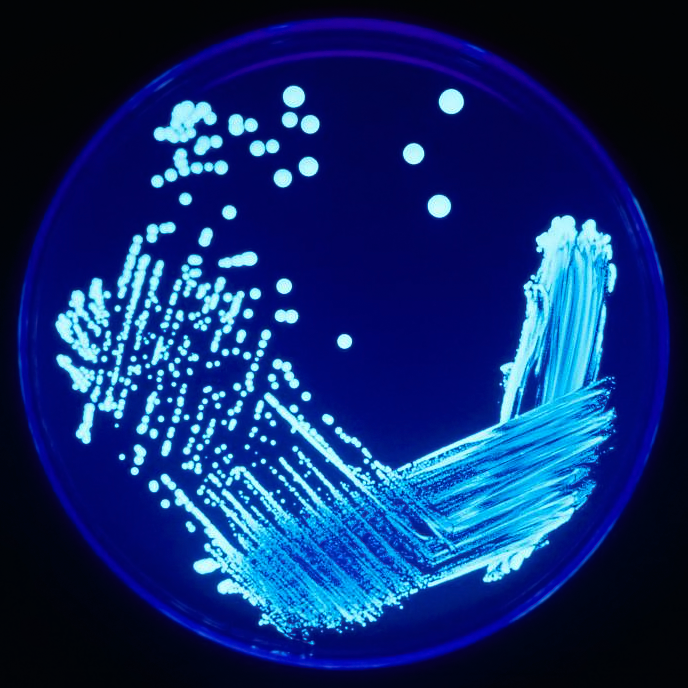
In a microbiology lab, "streaking" means taking an inoculation loop (the straight line with a circle on the end of it), and streaking it across a petri dish in a way that isolates individual bacteria, that go on to grow out pure colonies that the microbiologist can then identify. It's a bit complicated, but basically you wipe a sample swap on the dish, which has nutrient-rich growth media on it, spread it out one way, turn the plate a bit, spread it out in another direction, and so on. On my quilt block I deiced to make the streak lines yellow, then add my interpretation of the bacteria colonies in green. This is what it looks like for real:
I don't know why, but I LOVED streaking plates. Maybe it was because it was kind of like drawing. Maybe it was heating up the loop to glowing orange in our modern Bunsen Burner each time we changed directions of the streak. Maybe it's just 'cause I'm a bit odd. But I loved it!
Besides my fun-a-day quilt block, I also spent some time today getting my "New Orleans" art quilt out and finally pin basted it. I'm trying out "Hobbs batting" for the first time. My favorite is "Warm and White" up "till now. What's your favorite? It's ready to quilt now! Any suggestions? I'm linking up with "Freshly Pieced" WIP Wed (yes, I'm really late, AGAIN) to share what we're all workign on today. Feel free to offer suggestions on how to do the quilting (hint hint). I'm thinking "simple", but have had others tell me to "quilt the *^&% out of it"! (hee hee). I've been asked to enter it into our local quilt show. We're a small town, so it'll be no big thing, but big for me! Any tips on how to do a "show quilt" are appreciated too, as it'll be my first "show quilt". And don't worry... I'm a pretty mellow, type B personality, so my aim is more to share than win LOL!
Anyhow, thanks for reading! I've been really having a lot of fun with this, and am ALMOST sad to be seeing it come to an end in just a few days. But all good things must eventually come to and end!
Tuesday, January 25, 2011
Fun-a-day 25: Pneumonia
Yep, it's that time of year, cold and flu season! I've had a sick kid at home the last few days, but it looks like he's on the mend. Rarely, though, these not-so-fun illnesses can progress to pneumonia, as has happened to another family member of ours in another city. I hope he feels better soon! I've had pneumonia once as well, when my kids were both toddlers, and it really can wipe you out for weeks to months!
There are many causes of pneumonia, but one of the main ones we saw in the lab was caused by a bacteria, Streptococcus pneumoniae. On a sputum or "bronc lavage" specimen, they appear as gram positive diplococcus, which are the dark dots in pairs on my quilt block. Since it's a gram stain, the white cells, which are typically quite numerous, appear pink.
For fun, I drew a "goblet" cell (far left), which we would occasionally see in a bronchial wash specimen, which is a special collection method done in the hospital. These little cells line the respiratory walls, and have little hairs, or cilia on them that trap foreign particles. The white cells (on the right) are in there gobbling up the "bad guys", in this case, bacteria, and we do in fact frequently see the bacteria inside of the cell that's just "eaten" them. So cool! It still amazes to me, after all of these years, to think (and actually be able to see) that we have these little single cells in our bodies, all constantly working together, each doing their job to keep us healthy. It's also equally amazing that a tiny virus or bacteria can make us so sick! I sure hope all of you reading this are healthy and doing well!!
Here's one last picture of my stack of blocks after I trimmed them all up tonight! FUN!
Monday, January 24, 2011
(Not so) Fun-a-day 24: Leukemia
I've been avoiding today's block, as it's probably the cell we med techs dread seeing the most. But it's also among the most critical things we see under the microscope. Leukemia is a cancer of the blood, or bone marrow (where the blood is made). There are many different types, depending on the blood cell line that it originates in. I "drew" acute lymphoblastic leukemia. The cells are what we call "blasts", or very early immature lymphocytes. They have nuclei that are really open and lacy, and very little cytoplasm (the light blue). There are also typically many, many of them, and they all look very much alike. Because they multiply unchecked, they can exclude other types of cells. The white cell count can also skyrocket.
The absolute worst cases are those involving children, especially when we are the first ones to diagnose it. We hate that call to the doctor or nurse, knowing a patients' life is about to be turned upside down. Luckily there has been much improvement in the care of leukemia patients, and hopefully that trend will continue. Unfortunately it's the most common cause of cancer in children, and is much too common in both children and adults. Among the few dozen blogs I follow, I can think of at least 2 who have family or friends battling this cancer right now. It's certainly something I personally saw much too often in the lab, as just one case is too many. I dream of a day where leukemia and all cancer has a permanent cure.
Sunday, January 23, 2011
Fun-a-day 23: Pelger-Huet and my birthday!!
Yep, it's my birthday! Not only that, but it's my twin brother's birthday as well! Our birthday had me thinking about genetics. In a typical hospital lab, there's many many tests that we just don't do, sending them out to a big-city lab. Genetic testing, is one of many specialties that we didn't do. Pelger-Huet anomaly is a very rare genetic disorder that causes no symptoms in people who have one copy of the gene (heterozygous), and non-life threatening symptoms in those with 2 copies (homozygous). But it does cause a striking view under the microscope, as all of the neutrophils only have 2 lobes of their nuclei, instead of the typical 4. They look like eye glasses. And of course I see them as "twin" lobes. I've also seen this in animals too. It's something I saw only a couple of times.
On my quilt, the Pelger-Huet cells have the bi-lobed dark nuclei, and as usual, I had to throw in some RBC's and platelets to keep them company!
Thanks to my friend, Laura, I'll be eating key lime pie for the first time ever for my birthday. My hubby's making burgers for the grill as I type! It'll be as close as we can get to being in sunny Florida! Maybe we'll even put on some Jimmy Buffet too! Laura has been incredibly busy writing travel guides for Moon Guidebooks, including one that JUST came out for the Florida Keys. She also has a blog, and this recent post is what got me craving some yummy pie! My brother (and mom) are both in the Dallas, TX area, so phone calls will have to bring us together today.
Saturday, January 22, 2011
Fun-a-day 22: Spinal Tap and Meningitis
For today's block, I decided to try to "draw" what we'd see on a "hemocytometer" when we look at spinal fluid in a patient with meningitis. A hemocytometer is used when we want exact counts of cells in a specific amount of liquid. When we fill the very precise chamber with fluid, using a tiny pipette, only a certain amount of fluid covers the grid lines on the special calibrated glass slide. It has grid lines that we can use to count and calculate the number we see. Yes, lots of math! We not only count spinal fluid cells this way, but also body fluids like pleural or peritoneal. We also use the hemocytometer to count sperm in the sperm count.
A normal spinal fluid sample would have almost nothing in it. It's a crystal clear fluid that surrounds the spinal cord and brain. A spinal tap is very invasive, so we treat the samples in the lab with great care and urgency. We usually run many tests on it, from cell counts, types, cultures, chemistry, and some are even done at the bedside. If we do see a significant number of cells, we'll do a differential, letting the doctor know what type they are. This is important, because once again, if it's a virus, the cells will mostly be lymphocytes. If it's bacterial meningitis, we'll see mostly neutrophils. Bacterial meningitis is an incredibly serious illness, and is also contagious. Thank goodness that we now have some vaccines to help prevent some of the bacterial meningitis, as it's one of the most devastating illnesses we can see in a young child or a young adult.
Once again, this is a "wet prep", so no pretty colors. Since my husband grew up in Chicago,['; I decided to use some orange thread to go with the blue background (Go Bears!)!! I also tried using 2 top threads instead of 1. The little round circles are supposed to be white blood cells. I'm not too thrilled with the result, or the whole block in general, but I can say I tried something new today!!
Speaking of something new, here's a new ebook cover that I put in my Etsy shop today! I LOVE this fabric!! Fun!
Friday, January 21, 2011
Fun-a-day 21: Antibodies
Gosh, have I had a busy day! I made up a few more kindle covers that I still hope to get in my Etsy store tonight, or tomorrow, and I almost finished making up the rest of my fun-a-day quilt blocks. They're like little canvases, but each still needs to be prepared. The method I'm using is called "quilt as you go", because that's what you do! So I have now made up 30 little quilt sandwiches, and 21 are now finished! All I'll need to do at the end is to connect them all together! That said, I decided to keep my quilting ridiculously simple tonight!
The symbol stitched on the quilt is that of an antibody. Antibodies are not only important in our bodies, but in the lab as well. We can't really see them on a microscope, or at least a light microscope. They're a protein chain, and are very tiny. The very ends of an antibody each recognize a very specific "antigen", or foreign protein. Our bodies make (and remember) an antibody to each virus or bacteria, or perceived "bad guy" that comes along. An antibody to Hepatitis B is different than an antibody to Influenza. As with influenza, and colds, and many other things, there is often many different types or strains.
Short story long, scientists have learned how to test for these antibodies. Not only that, but they've learned how to make these antibodies to use in testing, and indeed many of the tests we do in "special chemistry" in the lab use these in different methods. I couldn't even begin to list all of the tests where antibodies, are involved. That's why I decided to use it as a quilt block. If you've ever had blood drawn to be tested for Hepatitis or HIV, Rubella, or Lyme Disease, we're actually measuring and looking for the antibodies in your blood that shows if you've been exposed to these. Many tests, such as blood typing, TSH, and sex hormone levels (estrogen, testosterone levels) use manufactured antibodies as a way to test for these levels. The sophistication of some of these tests, and the instruments that run them are really quite incredible!
I also got nominated by my friend Beth, of Notes ... blog for a Liebster Award, bestowed upon blogs that could use a boost in followers… (should have less than 300 followers). If you haven't visited my friend Beth's blog, you really should! She's a quilter who moved to South Africa about a year ago. She's also an amazing photographer. She has some great subject matter to take pictures of!! She also has helped my via email both with my quilting skills and blogging and message board know-how. Thanks!
In return, I'm asked to nominate 3-5 other bloggers who could use a boost. I wish I could nominate all of you, because I really do enjoy everyone's blogs, and know just how much free labor they involve ;-).
Monika of My Sweet Prairie, Kit Lang, of Diva Quilts, and Caroline of Trillium are 3 of many blog that I go to get some inspiration!!
With that, I'm off to bed to read a bit while the wind howls outside.
Thursday, January 20, 2011
Fun-a-day 20: Urine Casts
I have been thinking a bit about kidneys lately. I'm a big fan of "professional quilter", Mark Lipinski, and have been following his Facebook updates, blog, and Internet radio show, "Creative Mojo". If you haven't listed to it, you really should (Wed. from 12-2 EST on Toginet radio)! Lately, he has shared his struggles with a genetic kidney disorder. It seems that I also have some "kidney issues" on one side of my family, and I also have been trying to make some sense of it. So, I decided to "draw" urine casts on my block today. These are generally seen in the urine when a person has kidney problems. The problems can be many things, including kidney infection, and kidney failure.
On my block, I also put an epithelial cell (skin cells) all the way to the left, which is normal in a urine sample. Next to it is a "cellular cast". At the top right is a hyaline cast, which can be seen sometimes in healthy patients. Below it is a "granular cast", and a "broad waxy cast" is on the bottom. These are usually only seen in cases of severe kidney disease. There are other casts as well. They're formed when an excess of protein is present in the tiny tubes that collect urine. The protein (which is not normally present in urine) make things "sticky", catching cells and such. They eventually break free, which is just what a cast is.
On another note, I sold my first ebook case!!! Whew hew!!!
Just got to add, that I started this post in the afternoon, right before I had to make a fast dinner for the family (elk steak chunks wrapped in bacon, broccoli and couscous), then take the boys to karate lessons. I didn't quite finish. Karate lessons are not just karate lessons! They are also our "date nights" (DH and I). We drop them off, then have a blissful kid-free hour at the local coffee house, The Great Pacific (that also sells beer, wine and food)!! Sometimes we go to a new brew-pub, The Prodigal Son. It is so totally worth the money we pay for the lessons! No doubt that my kids will someday become black belts, because we just don't want to give up our date nights!!! Tonight when I we were driving home from karate lessons, I was talking to the kids about my blog, but I also had to go to the bathroom, so "Becky's bladder" was what the kids heard!! OMG! LOL! Just thought that it was so fitting for today's post! And it's funny how one thing leads to another! By the time we got home (only a 4-5 minute drive), I was telling them stories about how my mom spent part of her childhood in a house that had "no indoor plumbing"! LOL!! True story! It's amazing how fast things change! I love telling my kids family stories like these. They're so important!
Wednesday, January 19, 2011
Fun-a-day 19: Mononuceosis and atypical lymphocytes
Are you still with me? I hope so!
Again, I know that mono isn't fun at all, but again, under the microscope it is quite a distinctive illness. I totally am guessing here, but I believe it was named "mono", because of the abundance of atypical lymphocytes that we see in a blood smear that resemble monocytes. In any viral disease, the lymphocytes are the heroes. They multiply rapidly, fighting off the viral infection. In the process, they appear "reactive" on the slide... the nucleus (purple) gets a bit spread out and lacy, the cytoplasm (light blue) can get quite blue and almost seems to get a bit sticky. It can look like it clings to the red blood cells on the slide. This is a very simple "drawing" of what it looks like. A well-seasoned med tech can spot mono right away. We always noted the atypical lymphs on the differential, and often called the doctor or nurse to alert them to our suspicion (they usually weren't surprised). For some reason, these mono infections just look a bit different than most other viral illnesses. Of course with any viral illness, there's only so much the doctor can do, as antibiotics aren't effective against the virus, but can help if a "secondary" bacterial infection occurs.
Sorry for the bad lighting the last few days. I've been taking them at night, but better late than never, right? Speaking of late, I know it's way too late but I'm linking up with "Freshly Pieced" WIP Wed blog again. We West Coast folks have a bit of a disadvantage time-wise for these linky parties, but maybe there's still a few of us still on the blog-o-spere!
Tuesday, January 18, 2011
Fun-a-day 18: Left Shift, and new Etsy shop!
Just like the bone marrow goes into overdrive making reticulocytes when there's blood loss or anemia, it also goes into overdrive during a bacterial infection, making lots more neutrophils, the white blood cell type primarily responsible for fighting bacterial infections. They are also kicked out a bit young as the body is trying to recover, and we see this in the nucleus (dark purple). The nucleus is "band" shaped, and indeed we call these bands in our white cell differential, or "diff". We look at 100 white cells (under the microscope) in the "diff", and type or sort them, giving the doctor a percentage of each. If there is a high overall white cell count, and a marked "left shift", the doctor knows that the patient has a severe bacterial infection. This can be seen in pneumonia, blood poisoning, or appendicitis. This can be really helpful especially when the patient comes through the ER or has symptoms that can be various things. Of course I had to put some RBC's and platelets in there too!
But the thing I'm most excited about today is that I got my Etsy store up and running! It was a bit of a learning curve, but I think I got it. I hope to add to it and make it "better" as I go along. I made a few of these ebook cases for family and friends over the holidays, and got such a good response that I'm trying to sell some, as well as iPad covers. Wish me luck! Here's the store link: http://www.etsy.com/shop/SolarThreads?ref=pr_shop Since we have 12 solar panels on the top of our house, I decided to call it "Solar Threads". I'd love any feedback, good or bad if you got a minute!! Thanks!
Monday, January 17, 2011
Fun-a-day 17: Reticulocytes
Reticulocytes are basically brand new red blood cells that have just entered the circulation. They are normally about 1% of the total population, but can be increased when the body is working hard to produce new blood cells, as in cases of anemia. Doctors like to see this response, because it means that the bone marrow is normal and working well. In cases of a low count, this means that the bone marrow isn't working as it should. This can be due to several reasons, including bad diet, leukemia, or aplastic anemia.
In the lab, we use a special stain that stains RNA that is present in only very young red blood cells. The red blood cells all stain a beautiful blue-green. In my quilt block, the reticulocytes are the cells with little black spots. You'd normally not see so many "retics" in one "field", but hey, this is a quilt, so I had fun making quite a few of them. A once time-consuming test, we'd make the smear, stain it, then actually count several fields of 100 cells, and note how many of these were reticulocytes as an averaged percentage. When I started working in the lab in the early 90's, that's how we did every retic count. In 2006, when I left, almost all retic counts were then being done on our automated hematology instrument, saving us a lot of time. As the lab gets more and more automated, we worried as med techs that our jobs will be replaced by instruments. I don't think that'll ever happen, but certainly our jobs change as we do less hands-on work, and more instrument trouble shooting.
On a totally separate subject, it's Martin Luther King Jr. Day. I grew up, and attended public schools in the deep South, and was part of the desegregation busing that took place there in the 70's. I feel fortunate that my parents believed in racial equality and continued to send me to public schools, even as many were being sent to private schools. I think I learned so much more than math and science by attending the schools that I did. I hope to continue Martin Luther King Jr.'s dream as I raise my own kids.
Sunday, January 16, 2011
Fun-a-day 16: Bird blood
As I mentioned yesterday, I had zero training in veterinarian lab science in school. Everything I learned, I learned on the job. So it was a huge surprise to me to see my first bird blood sample. All of the red blood cells in birds' circulation have nuclei in them (the black centers). Apparently all animals except mammals, have nucleated mature red blood cells. People, dogs, cats, horses, and even llamas (yes we got those too) have no nucleus in the mature red blood cells after they leave the bone marrow. We rarely got bird blood in the lab. Birds don't live too long, in general, and I suspect there just isn't as much a vet can do for a sick bird, so it's not something we saw much at all in the lab. All of our instruments were designed for humans, so animal blood was a bit of a challenge for us. But each time we did get a bird sample, it was something of a "come see this!" sample. We loved seeing new and different things in the lab, and this was no exception.
I didn't even try to "draw" any platelets or white cells, because I just don't remember them at all, but the red cells are pretty fun to look at all by themselves!
Saturday, January 15, 2011
Fun-a-day 15: Veterinary Medicine, Heartworm
One thing medical technology school didn't teach me, and that surprised me when I first started work, was that many medical labs also do veterinary testing. Animals get sick too, after all, and lab tests, like chemistry panels, and complete blood counts can help the veterinarian diagnose and treat our pets and livestock.
Heart worm is another mosquito-borne parasite that can be seen in the animal's blood. It was something that we would occasionally see on a blood smear. They're quite big, and it doesn't take too much imagination to see how this would cause problems for the animal. As with other parasitic infections, often there would be an increased number of eosinophils in the blood. Once again, these are white blood cells that help fight infection, and "specialize" in parasitic infections, as well as allergy response. The "worm" on the quilt block is a "microfilaria". The orange cells are the eosinophils. I put red blood cells and a lymphocyte on it as well for fun.
Surprisingly, dog blood appears very similar to people blood when viewed under a microscope. One of my favorite "lab party tricks" was to take the "fresh" blood out of the test tube from an infected dog and view it under low power as a wet prep. These microfilaria often would still be alive and we could watch them move around. I know, it's a bit warped, but we had to do something in the lab to entertain ourselves...
There are a very few parasites that will form microfilaria in human blood, but luckily I've never seen these. I think Loa loa (found in Africa) is one of them, but don't quote me on that. It's been a while since I had parasitology!
Luckily there is prevention and treatment for dogs who get heart worm. In fact our family pet dog growing up was infected when we brought him home from the pound, and recovered to live a long and happy life.
Subscribe to:
Posts (Atom)